Real estate agent interviews: 10 questions to ask

Every agent you meet will come ready to win your listing. Before you choose one to sell your home, ask each of them the same 10 questions, in this order, so you can compare the evidence rather than the pitch:
- Which homes like mine have you sold recently?
- What's happening in the market for homes like mine?
- How would you sell my home to buyers?
- Which sale method do you recommend, and why?
- What marketing do you recommend, and what will it cost?
- What price do you expect, and which sales is that based on?
- How long do you expect it to take, and what if it doesn't sell?
- Who will run my sale day to day, and how will you keep me updated?
- What commission do you charge, in dollars?
- What agreement would I sign, for how long, and how do I end it?
NSW Fair Trading suggests talking to at least three agents. From each, a good answer is specific: real sales, real costs and real names.
Several answers, such as the commission, the marketing costs and the term (how long the agreement runs), will end up in the agency agreement, the contract that appoints the agent. So it pays to pin them down now.
1. Which homes like mine have you sold recently?
An agent's recent sales near you tell you more than their years in the job.
A good answer names specific sales of similar homes nearby, with the price, how each was sold and how long it took. Ask, too, for the contact of a recent seller you can call. When you do, ask whether the final price matched the agent's first estimate and how often the agent was in touch.
A red flag is talk of awards, years in the business or total sales, with little about homes like yours.
It's also worth checking their licence. NSW, Victoria and South Australia, for example, have public registers you can search.
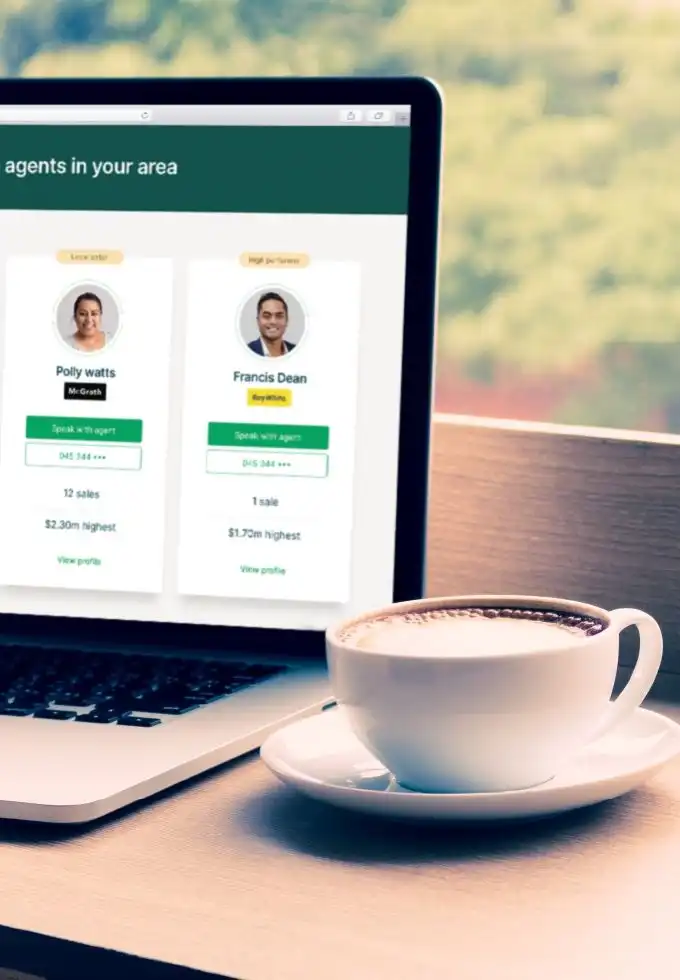
You can compare agents by their recent sales near you to see how your shortlist stacks up.
2. What's happening in the market for homes like mine?
The answer shows how well the agent knows your local market.
A good answer gives local evidence: recent sales nearby, how many groups are coming through open homes, how long similar homes are taking to sell, and whether any buyers recently missed out on a home like yours.
A red flag is a general line such as "it's a great time to sell", with nothing local behind it.
3. How would you sell my home to buyers?
Ask for the 30-second pitch: what they'd emphasise about your home, and which buyers they'd aim it at.
A good answer picks out what's genuinely different about your home, names the likely buyers, such as young families or downsizers, and says how the agent would reach them. It may also cover what's worth fixing before you list, if anything.
A red flag is a pitch that could describe any home in the street.
4. Which sale method do you recommend, and why?
The main methods are a private sale (also called private treaty), where buyers make offers through the agent, and an auction. Some states also use tenders, where buyers submit offers by a closing date. Victoria also has fixed-date sales, where buyers must make their offer by a set date and time.
A good answer ties the method to your type of home, your area, the market, your timeframe and what you prefer, with recent local results to back it up.
A red flag is the same method for every home, whatever the market.
In Victoria, if you choose an auction or a fixed-date sale held from 16 October 2026, your reserve (the lowest price you'll accept) must be published at least 7 days before the sale.
If the agent recommends an auction, our auction or private sale guide sets the two side by side.
5. What marketing do you recommend, and what will it cost?
You usually pay for the marketing yourself, separately from the commission.
A good answer is a written plan listing each item, such as the online listing, photography and signboard, with the cost of each and when it's payable.
And ask what happens if the home doesn't sell. Consumer Affairs Victoria and Consumer Protection WA say you still pay the marketing costs set out in your agreement, unless you've negotiated "no sale, no fee".
A red flag is a single package price with no breakdown, or reluctance to put it in writing.
Most states require the agreement to list the marketing costs and any rebate or discount the agent gets on the advertising you pay for. In Victoria, the agent must pass any rebate on to you. For what a typical package includes, see what it costs to advertise a home.

6. What price do you expect, and which sales is that based on?
The evidence behind the figure matters more than the figure itself. Ask this once the agent has seen your home and you've talked through the method and marketing.
A good answer is a figure or a narrow range, backed by recent sales of similar homes nearby and how your home compares with each.
In Victoria, NSW and South Australia, this estimate goes into the agreement. In the ACT, it goes into a sales inspection report that forms part of the agreement. Because it's written down, it's worth getting right at this stage.
In Victoria and NSW, a range can be no wider than 10 per cent (for example, $800,000 to $880,000). In South Australia, the estimate must be a single figure. In Victoria, it must also take into account the three most comparable recent sales, or fewer if there haven't been three.
A red flag is a figure well above the other agents', with little behind it. Giving you a high estimate to win your business is called overquoting. Consumer Affairs Victoria says doing it deliberately is illegal in that state.
For what each state requires the agent to give you, see our guide to comparing property appraisals.
7. How long do you expect it to take, and what if it doesn't sell?
Ask how long they expect the campaign to run, when offers should start arriving, and what they'd do if they don't.
A good answer gives a timeframe based on how long similar homes nearby have taken, and a plan for reviewing the price, the marketing or the method with you if interest is slow. Our guide to how long it takes to sell a house explains what affects the timing.
A red flag is no plan beyond the first open home, or a hint that the price will need to come down soon after you sign. In Victoria and NSW, if the agent's estimate stops being reasonable, they must tell you in writing, with reasons or evidence, and update the agreement.
8. Who will run my sale day to day, and how will you keep me updated?
The agent you meet may not be the person who shows buyers through or negotiates with them. Ask which staff will run the open homes and negotiations, and what experience they have.
A good answer names who does what, says how often you'll hear from them (after every open home, for example), and shows you a sample of the report you'll get.
A red flag is a vague answer about "the team", or no clear plan for updates and buyer feedback.
In most states and territories, the rules say your agent must act in your best interests. They must also pass on the offers they receive. In NSW, Victoria and the ACT, you can tell them in writing not to.
The details differ by state, so ask how they'll present offers to you, and how they'd answer a buyer who asks for your lowest price.
For what good communication looks like, see our guide to how much your agent should tell you.
9. What commission do you charge, in dollars?
Commission is the agent's fee for selling your home, often a percentage of the sale price. It isn't set by law, and you can negotiate it.
A good answer gives the commission in dollars at a few realistic sale prices, says whether it includes GST, and explains what it covers and when it's payable. It's usually due once the home sells, but check what the agreement says if a sale falls through.
A red flag is a rate with no dollar figure, or fees beyond the commission and marketing that only turn up in the agreement. NSW Fair Trading suggests asking for a printed list of the agent's fees, commission and expenses, such as advertising.
If the commission is a percentage, in NSW, Victoria and the ACT the agreement must also show it as a dollar amount. In Victoria, the agent must tell you before you sign that commission is negotiable.
For how commission is usually structured, see our guide to real estate agent fees and commission.
10. What agreement would I sign, for how long, and how do I end it?
The agency agreement (a sales authority in Victoria) sets out the commission, the marketing costs, how long it lasts and how it ends.
A good answer explains the type of agreement, such as a sole or exclusive agency, where you appoint only one agent, usually for a set period. It also covers whether you'd still pay commission if you found a buyer yourself, how long the agreement runs and how either of you can end it.
The agent should be happy for you to take it away and read it.
A red flag is pressure to sign on the spot.
If you do sign, NSW is the only state or territory whose agency laws give you a cooling-off period (a short window to change your mind). It ends at 5pm on the next business day or Saturday, whichever comes first, unless the agreement or the agent extends it in writing.
If you signed a valid waiver beforehand (a form giving up the cooling-off period), you don't get one.
If an agent approached you uninvited, at your door or by phone, and you signed as a result, national rules on unsolicited sales may give you 10 business days to cancel. Otherwise, once you've signed, how you get out depends on the agreement's own terms and your state's rules:
- Queensland: a sole or exclusive agreement on a home can last up to 90 days at a time. If it runs 60 days or more, either of you can end it on 30 days' written notice, though not before day 60 unless you both agree in writing.
- South Australia: up to 90 days. If the agent sends you a notice of expiry, you can refuse an extension or agree in writing to one of up to 90 days. If you do nothing, it's extended once, for 180 days, and you can end an extension by written notice.
- Tasmania: up to 120 days, and either of you can end it by giving no more than 30 days' written notice.
- NSW and the ACT: an agreement for a fixed term over 90 days must let you end it on 30 days' written notice after the first 90 days, unless you're building the home for the buyer under the sale contract.
- WA: the law sets no limit, so the term and how it ends are whatever the agreement says.
- Victoria and the Northern Territory: you can't end it during the agreed period unless the agent agrees.
Commission can outlast the agreement, so ask whether you'd owe it if you later sold to a buyer the agent introduced, and for how long. If you change agents, end the first agreement in writing before you sign the second, or both may be able to charge you commission.
Our guide to structuring an agent agreement covers what to negotiate before you sign.

Choosing your agent
Choose the agent whose plan and evidence you trust most, not simply the highest estimate or the lowest fee. Before you sign, check the agreement shows:
- the commission in dollars, and whether it includes GST
- each marketing cost, and whether you pay it if the home doesn't sell
- the price estimate, if your state puts it in the agreement, backed by sales the agent has shown you
- how long it runs, and how you can end it
- whether you'd owe commission after it ends, and for how long.
If none of the agents convinced you, you can compare more agents in your area on their recent sales and reviews. For every step from here, see our guide to selling your home.
Where this information comes from
The state rules come from the real estate agent laws of each state and territory, and their consumer affairs pages, as they stood on 20 October 2026.
They include Consumer Affairs Victoria's pages on selling with an agent and sale method and price, NSW Fair Trading's agency agreements page and consumer guide, the Queensland Government, the South Australian Government, Consumer Protection WA, Tasmania's Property Agents Board, the ACT's Agents Regulation, the Northern Territory Government and, on unsolicited sales, the ACCC.